Sunday, December 15, 2013

In which I review several Regency books

http://minimumwagefaeries.com/sch8p4.html


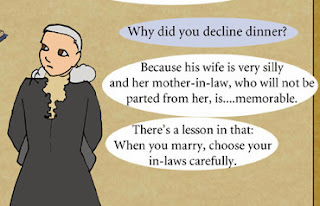
I have to agree that most women of Regency Romance are quite silly. I've read several of them recently, though it's not my usual thing.

Jane Austen's Guide to Good Manners-
Misrepresented. Unhelpful. No substance. 1/5 stars.

Georgette Heyer's Regency World-
One Word: YES. Just the thing for any writer interested in the Regency period. Too bad it's 50 years too late for me.

Kiss Me, Annabel by Eloisa James- It wasn't the title that forced me to read this book, it was the first two sentences. "The day the Scotsman came to Lady Freddrington's ball, Annabel's sister decided to give him her virtue, and Annabel decided not to give him her hand in marriage. In neither case had the Scotsman indicated a particular interest in undertaking such intimate activities with an Essex sister, but his participation was taken for granted."

As an opening, I found the snark irresistible. As a book, I preferred the Regency half to the romance half, but that's a matter of taste. The author knew the period, and the characters were interesting and entertaining. As Regency romance goes, it's about as good as they get.

The Nonesuch by Georgette Heyer. Fun, funny, witty, and I don't have to skim past all the awkward smutty scenes. Makes me want to go back to the library and get more of her books. I even came to like the whiny Laurence by the end of the book. I expected he would be maneuvered into marrying; but no. Way to foil my expectations, Heyer! Do that again!

Anthony Adverse- Another thumbs down. I read several chapters and in the end consulted Wikipedia to find out when the title character would appear. The beginning of the book is apparently about A.A.'s parents. I could see his mother was a complete ninny; and his father meant to run away with her, but they end up trysting instead, for an extended while, meeting secretly for weeks; until A.A.'s father is killed by the jealous husband. Totally had it coming. Didn't finish the book.....

Sunday, December 8, 2013

Circulating libraries

http://minimumwagefaeries.com/sch8p1.html
I skipped Chapter 8 and started on 9 because I was having so much trouble with writing 8. But as soon as I did, the problems started resolving themselves, at least a little bit. It's better to put first things first.... so I'm halting 9 and posting 8, so long as it cooperates. Conversations that refer back to the events in 8 will make more sense that way.

The other problem I'm running into is that I lack reference photos and background shots and general information for town life. Most of what I can find dates to 1800-1850, and there's a HUUUGE amount of difference between the time periods. Look at a family photo album from the 1960s. How bout those beehive 'dos? That kind of difference. Or imagine taking a guidebook printed in the 1960s, and trying to tour New York with it. That kind of difference.

As for this page, I'm not much good at drawing horses (any 8 year old girl could do as well), and I'm not so sure about carriages either. The person driving DID ride one of the horses, rather than a bench on the front of the carriage, as later in the 1800s. Top hats weren't in use yet. That's the Stanhope crest circa 1800 on the side of the carriage. Yes, it's a private carriage and not a rented one. Remember Mr. Bennett's comment in Pride and Prejudice about needing the carriage horses for the fields? The Stanhopes don't have that problem.

Okay, on to circulating libraries! Books were expensive. Few people would own many, although those who were rich and so inclined might take pride in having a huge private library. In the early to mid 1700s, circulating libraries started to spring up. As a member, you could read the latest news and borrow books, all for a hefty quarterly fee. There were only a handful at this time, so he's excited to see one here. As time went on the idea really gathered steam, and by 1800 there were over a hundred in London alone.

Libraries were not just there to loan books; people went there to socialize as well, and the hefty fee made certain those people were "the right sort." Women were permitted. When you consider all the places they were NOT welcome (clubs, bars, hotels, banks, moneylenders), it's no wonder they flocked to the libraries, even if they were derided for preferring novels to more edifying literature.

I was not able to find out how these circulating libraries kept track of memberships. Will Allan have to pay to make it in the door, or just if he tries to borrow a book? I assume he bluffed his way in. I also assume that if I can't find out, my readers probably won't know either. If you do, though, speak up.

Last paragraph, then I'll stop boring you: at work this week, appraised several Masonic books (one in cipher) and a library book from 1860 titled Memoirs of the Pretenders. (link to the Ebay auction). I actually knew what was meant by the Pretenders, so it was fun to be in on the joke.

Tuesday, December 3, 2013

Love and a black eye

http://minimumwagefaeries.com/sch9p5.html
Notice Allan's proud, chagrined expression. He really shouldn't have fought that common fellow, and he knows he's going to hear about it later.

Also, about the manhandling:

I've noticed something about men; when they express affection, it's often accomplished through harassment. I would say "mild harassment" but sometimes it isn't so mild. Depends if you understand the subtext or not. My husband says this is a trait of immature males, but I'm not so sure.

Women and girls tend to express affection through nurturing and efforts to please. Take a cat; a woman will feed and stroke it, and scratch the sweet spot under the chin to make it purr. A man might ruffle its fur, tweak its tail, attack its belly, generally tease it, and laugh at its indignant expression.

Men who are good friends might trade casual insults as a greeting. If two women do that, there's nothing casual about it and you'd better break it up before they start pulling hair.

We know boys tease the girl they like. I can also attest that young fathers like teasing their toddlers, chasing them around the house, tickling them til they scream, and issuing various playful threats, from "I'm gonna get you!" to "I'll sell you to the gypsies!" Which just goes to show how early we learn to equate male aggression with affection- if you take these threats at face value, they're pretty disturbing.

With this understood, catcalls such as "You so foooiiiine!" can be understood. I guess. At least the subsequent "I was giving you a compliment, bitch!" can be chalked up to the difference between Venus and a very primitive Mars. But that veers over into control and aggression more than affection.

But back to my topic. Is Allan manhandling Siloen a sign of affection, like teasing a cat? Or a show of aggression and control, since Sally wounded his pride? Or perhaps, practically speaking, he's trying to keep her from picking his pockets.

Not that Allan isn't an insensitive jerk, but there's a lot of cultural conditioning involved.

Sunday, December 1, 2013

Green moppet

http://minimumwagefaeries.com/sch9p4.html

One senses there must be more to the story. I won't make you wait long for it.

If, by any chance, you enjoy my comic and want to make my season bright, check out the things I have for sale on Ebay. I wish I could say I'd blow the money on something fun and outrageous, but the truth is my water heater has been making some amazing noises and needs to be replaced.

I just posted the first of this week's updates, and I'm listening to disaster documentaries while I start sketching on next weeks. Those still cheer me up.
Bonus sketch

Wednesday, November 27, 2013

New outfits

http://minimumwagefaeries.com/sch9p2.html
So happy to be drawing at this again. Her unrestrained enthusiasm makes my day.

As you see, the boys have new outfits.

Stephen, as the grandson of the deceased, is ready to leave off the black and wear colors again. Allan, a son, should be wearing black for some months yet, but he wanted to show off his handsome new coat to his dear Sally. And how did that work out for him...?

Fashions have changed slightly. The skirts of the coats are less full, the cuffs less wide. Later in the decade, "big hair" will catch on, but that's a couple years off.

Looking at European portraits of the time, the gentlemen tended to wear bright jewel tones, the ladies pastels, and anyone in dull colors is working class. Men in American portraits tend toward more earthy tones of green, brown, and rust tones. Gainsborough is a good artist to refer to, since he worked both sides of the Atlantic.

There was never any question of what color Allan would wear: a blue that sets off his eyes. Stephen was more of a challenge. Purple is too royal a color, orange too modern. Perhaps I should have gone with yellow/gold, but he would be constantly upstaging Allan. Allan should be the more visible of the two. Green would have been a good color for Stephen, but it would fade into the greenery too well. Bright red was too attention-getting, so I went with a dull rust red, although he could afford better. He seems like a person who would be happy to fade into the background.

There should be an extraordinary amount of trim, embroidery, and buttons on this, but that takes too much time to draw for every page. I settled for adding more lace and ruffles.


Wednesday, November 20, 2013

Siloen's song

That last post was a bit sad. So hey, I was listening to this song today, and it's so beautiful I thought I would share. The theme is from a short-lived rather apocalyptic anime series called Arjuna. Arjuna's main flaw was that the soundtrack was several times better than its plot. This theme didn't even make it into the series, although it was the gem of the third soundtrack, which was mostly odds&ends. The lyrics are not in any known language, and my only complaint about it is that it is way too brief, because I could listen to it just about forever.

If there is one song that most evokes the character Siloen, this is it.

Darn, now I need to find themes for each of them. I'll take suggestions....

Also, I highly suggest the 1st Arjuna soundtrack, Into the Another World, for getting into a creative mindset. It is one of the most amazing things I have ever heard.
 

Tuesday, November 19, 2013

Parenting in the fantasy genre

http://minimumwagefaeries.com/sch7p20.html
So hey, maybe it's time for me to explain what this story is about, at least a little bit. Why I'm writing it.

-I enjoy reading fantasy. I have a creative mind and like to exercise my imagination. But the number of clichés drive me to distraction. It's as though they pick from the same limited list of storylines, conflicts, and character types. It's like they all go to the same place, by the same route, when I want to go somewhere different. Somewhere new.

-Art is my therapy. This story says more about me than I like, probably. Hopefully I've obscured my hangups enough that they're not too obvious. If they are, well, keep it to yourself.

-It's the chance to question certain mainstays of the fantasy genre. Does love always have to be at first sight? Does fantasy always have to be epic and world-changing? Do characters have to be good or evil, or can they just be people, once in a while?

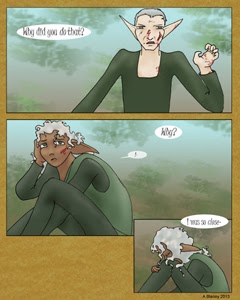
So, this post was triggered by this scene here. It begs some explanation. I got to say, these are two very dysfunctional families, and we've barely even met most of them.  Parents in fantasy are pretty static characters, usually:  a. conveniently dead b. evil as a plot device c. if they somehow get cast as main characters, probably on a quest to rescue their child. That's about it. (Bravo, Lois McMaster Bujold, your books are the exception).

I don't think I've ever seen a parent who was mentally ill, where mentally ill isn't equal to evil or abusive. Substitute overwhelmed, if you like. Depressive or unreliable would also do. I favor unreliable. Sometimes he's got it together, and other times he needs to be rescued from himself. Not going to say why, yet, that will come later.

I do know that not a word is said about it. Ever. Aille and Soreny share a look. That look says everything that needs to be said. As for why I know about that look, refer back to the Art is my therapy paragraph above.